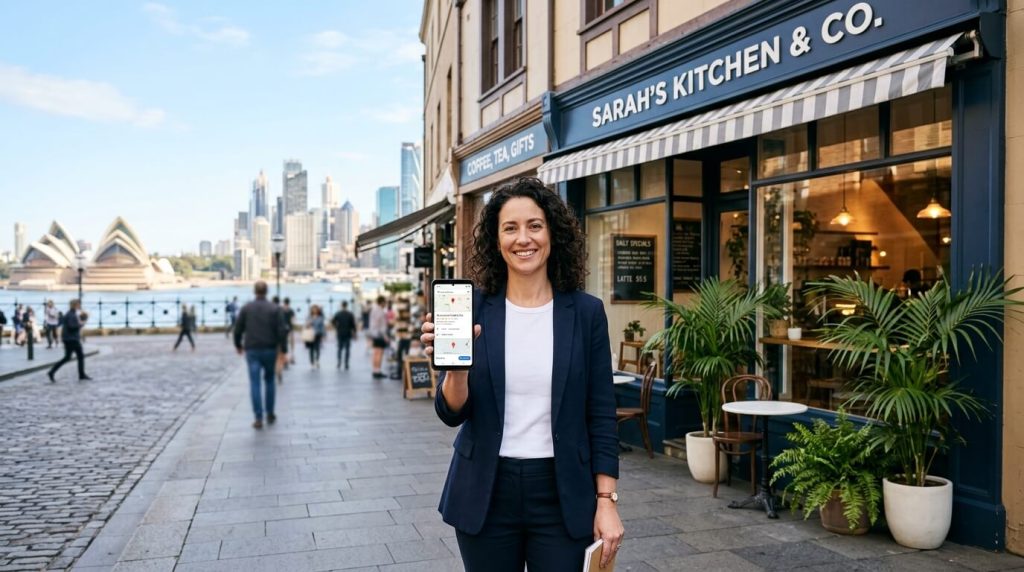

A practical digital marketing strategy for small businesses in Sydney begins with clear objectives, a reliable website and Google Business Profile, then coordinates a small number of channels that match how local customers search and enquire. In a market with hundreds of thousands of small businesses, scattered activity rarely produces consistent results.
Sydney and greater New South Wales host a large share of Australia’s small businesses. Australian Bureau of Statistics data indicate that small businesses (fewer than 20 employees) make up the vast majority of enterprises nationally, with New South Wales accounting for a substantial portion of the total. In this environment, most owners have limited time and budget. A focused strategy helps direct effort toward activities that support visibility and enquiries rather than attempting every channel at once.
Start with foundations that support local discovery
Most Sydney searches with commercial intent involve mobile devices and local signals. Google uses mobile first indexing, meaning it primarily crawls and evaluates the mobile version of a site for ranking purposes. A site that loads slowly or displays incomplete information on a phone creates friction for both users and search systems.
A clear, mobile friendly website remains the central destination for other activity. It should state what the business offers, the areas it serves, and how to make contact. Consistent name, address and phone details (NAP) across the site, Google Business Profile and major directories reduce mixed signals. Many businesses already have a Google Business Profile; keeping it complete and accurate supports relevance for nearby searches. Optimising your Google Business Profile provides a practical starting checklist for Sydney operators.
Define realistic objectives and audience focus
Effective planning starts with one or two measurable aims rather than broad goals such as “more awareness.” Common priorities for Sydney small businesses include increasing qualified phone or form enquiries, improving visibility for service plus suburb searches, or supporting a specific campaign.
Identify the core audience by location and need. A trades business serving the Inner West may prioritise different suburbs and search phrases from a professional services firm in the CBD. Note how customers currently find the business (referrals, maps, social, search) and where gaps exist. This step prevents investing in channels that do not align with actual buying behaviour.
Prioritise a small set of coordinated channels
Trying every platform simultaneously spreads limited resources thin. A workable sequence for many Sydney small businesses is:
- Secure the website and Google Business Profile foundations.
- Strengthen on page content that answers common local questions and describes services clearly.
- Maintain consistent social activity that drives traffic back to the site or profile rather than treating social as a standalone storefront.
- Review available analytics to see which searches or posts generate enquiries.
Content that addresses practical questions – such as what to expect during a service, typical timelines, or suburb specific considerations—supports both search visibility and customer trust. Social posts can highlight the same information in shorter formats and direct people to the relevant page. Digital marketing services often combine these elements so messaging stays aligned across channels.
Website design and development choices matter here. Logical navigation, clear calls to action and fast mobile performance help visitors who arrive from search or social complete the next step.
Measure what matters and adjust
Track a short list of indicators tied to the original objectives: form submissions, calls, direction requests from the Google Business Profile, and organic traffic to key service pages. Free tools such as Google Analytics and Google Business Profile insights provide baseline data without requiring advanced software.
Review results monthly. If suburb specific searches are bringing visitors but few enquiries, check whether the corresponding page answers the question and makes contact easy. If social engagement is high but traffic to the site is low, refine the links and calls to action. Small, regular adjustments based on available data usually outperform large, unmeasured campaigns.
Common pitfalls and a practical next step
Common issues include inconsistent NAP details, neglecting mobile performance, posting on social without a clear destination, and expecting immediate ranking improvements from limited activity. Local search visibility in Sydney also varies by exact location, competition and review signals; no approach guarantees a specific position.
Businesses that treat the website and Google Business Profile as the foundation, then layer coordinated content and social activity, tend to create clearer paths for local customers. Reviewing current pages, confirming mobile usability and aligning the next few pieces of content with real customer questions provides a concrete starting point.
FAQs
What should a digital marketing strategy for a Sydney small business include first?
Start with a clear website that works well on mobile and an accurate, complete Google Business Profile. These foundations support the majority of local searches before adding other channels.
How does mobile-first indexing affect Sydney businesses?
Google primarily uses the mobile version of a site for indexing and ranking. Sites with incomplete or slow mobile experiences can limit visibility for searches that often occur on phones.
Is it better to focus on one suburb or the whole of Sydney?
Many businesses see stronger results by targeting the suburbs they actually serve with accurate service-area settings and relevant content, rather than competing solely on broad city-wide terms.
How often should a small business review its digital marketing activity?
A monthly check of enquiries, Google Business Profile insights and basic website traffic is usually sufficient to identify what is working and what needs adjustment.
Can social media replace a website for local marketing in Sydney?
Social platforms help with awareness and engagement, but most local commercial searches lead people toward a website or Google Business Profile for contact details and service information. Coordinating both is more effective than relying on social alone.