
A practical content marketing strategy for Sydney small businesses starts with the questions local customers already ask, then organises answers into a small set of pillars and a sustainable publishing rhythm. It is not about posting every day or chasing every trend. It is about creating clear, useful pieces that help people understand what you offer, the Sydney areas you serve, and how to take the next step.

What a content marketing strategy means for a Sydney small business
A content marketing strategy is a short, written plan that decides which topics you will cover, why they matter to your customers, and how often you will publish. For most Sydney operators it centres on the website blog or service pages, with selected pieces shared on social channels or used in Google Business Profile posts.
Google’s guidance on helpful content emphasises material created primarily for people rather than to manipulate rankings. That principle fits local businesses well: customers search for practical answers about services, timing, suburbs and common problems. Content that meets those needs supports both visitors and longer-term visibility.
The approach works alongside other foundations. A clear website and an accurate Google Business Profile give the content somewhere reliable to live and be found.
Start with real customer questions
The fastest way to choose topics is to list the questions you already hear. Pull them from phone calls, enquiry forms, reviews, social messages and conversations in the shop or on site. Write them in the customer’s own words.
Examples for Sydney businesses include:
- “How long does a typical job take in the Inner West?”
- “Do you cover the North Shore and Northern Beaches?”
- “What should I prepare before you arrive?”
- “How do seasonal changes affect this service in Sydney?”
Group similar questions. Each group can become one or more pieces of content. This method keeps the work grounded in actual demand rather than generic ideas. It also produces natural language that matches how people search.
Build three to five content pillars
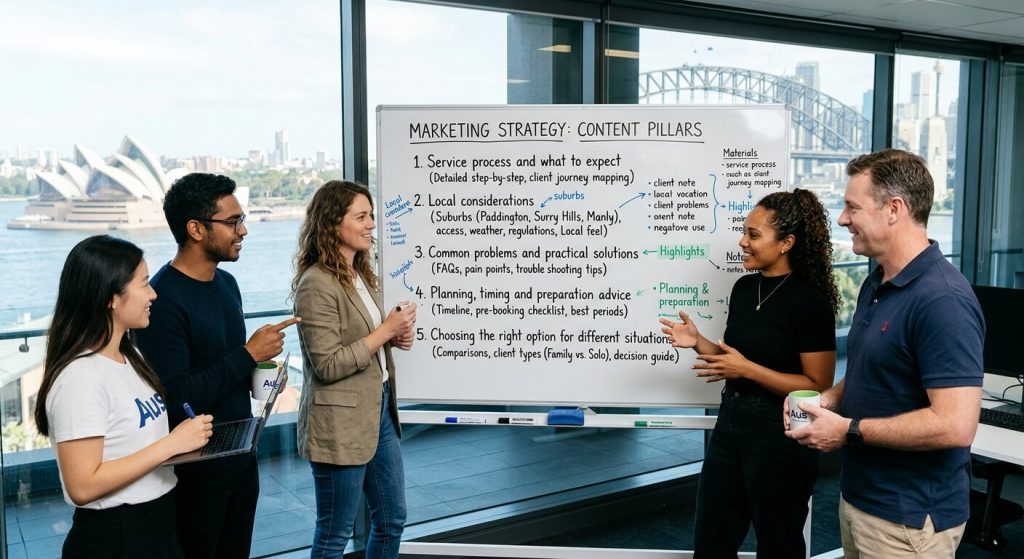
Pillars are the broad topics your business should be known for. They keep publishing focused and make it easier to add related pieces later. For a Sydney small business, pillars often combine the core service with local context.
Possible pillars:
- Service process and what to expect
- Local considerations (suburbs, access, weather, regulations)
- Common problems and practical solutions
- Planning, timing and preparation advice
- Choosing the right option for different situations
Under each pillar, list five to ten specific questions or subtopics. One strong article or page per pillar, plus supporting pieces that answer narrower questions, creates a coherent cluster. The cluster signals depth without requiring dozens of posts at once.
Create a simple content calendar you can keep
Consistency matters more than volume. A realistic starting point for many Sydney small businesses is one or two useful pieces per month, plus lighter social or profile updates drawn from those pieces.
A basic calendar includes:
- Date or week
- Pillar and specific question
- Format (blog post, service-page update, short guide)
- Channel (website, Google Business Profile post, social)
- Owner and status
Align some topics with Sydney’s calendar. Examples include summer preparation before peak heat, storm-season readiness, end-of-financial-year reminders where relevant, or school-holiday timing for certain services. Keep the majority evergreen so the library remains useful year-round.
Batch the planning. Spend one focused session each month choosing the next two topics from your question list, outlining the main points, and assigning creation. This reduces last-minute pressure.
Make the content locally relevant and useful
Local relevance comes from specificity, not keyword stuffing. Mention the Sydney suburbs or regions you actually serve, note local conditions that affect the work, and explain practical differences customers encounter. A page or post that helps someone in Parramatta or Manly decide whether to call is more valuable than a generic national overview.
Link new pieces to relevant service pages and to your contact or booking path. Keep name, address and phone details consistent with the website and Google Business Profile. The broader practical digital marketing strategy for Sydney small businesses shows how these elements fit together.
Review and update older content when information changes. A refreshed post that still answers the original question remains useful and signals ongoing accuracy.
Measure what matters and adjust
Track simple signals: which pages receive enquiries or form submissions, which search queries bring visitors, and which topics generate genuine conversations. Google Search Console and basic website analytics provide enough information for most small businesses to see patterns over a few months.
Drop or rewrite pieces that receive no engagement and no related enquiries. Expand topics that clearly help customers. The goal is a small, maintained library rather than a large unused archive.

Common limitations and realistic expectations
Content does not replace accurate listings, a usable website or genuine customer service. Results vary by competition, location, review signals and how well the content matches real search demand. No approach guarantees rankings or a fixed number of enquiries.
Most owners see clearer paths for customers within a few months of consistent, question-focused publishing, provided the website and profile foundations are already solid. Professional support with planning, writing or technical recommendations is available through content creation and brand communication services when the volume exceeds internal capacity.
Conclusion
A practical content marketing strategy for Sydney small businesses begins with the questions customers already ask, organises them into a few pillars, and publishes on a rhythm the team can maintain. Combined with a clear website, consistent local details and an active Google Business Profile, the content gives people the information they need to enquire with confidence.
Start this week by listing ten real customer questions. Group them into pillars and schedule the first two pieces. Small, steady steps build a useful resource that supports local visibility over time.
Frequently Asked Questions
How often should a Sydney small business publish content?
One or two useful pieces per month is a realistic starting point for most owners. Consistency and relevance matter more than high volume. Adjust once the process is working.
Do I need a long blog or can short pages work?
Both can work. Answer the specific question fully and clearly. Length should match the depth needed; shorter pieces that resolve a narrow query are often more effective than padded longer posts.
Should content mention specific Sydney suburbs?
Yes, when accurate. Naming the suburbs or regions you actually serve helps customers and reinforces local relevance. Avoid listing areas you do not cover.
How does content connect with my Google Business Profile?
Content on the website supports the same information and services listed on the profile. You can also turn key points into short Google Business Profile posts. Keep details consistent across both.
What if I already have some blog posts?
Review them against current customer questions. Update useful ones, combine overlapping pieces, and add new content that fills clear gaps. An existing library is a head start when it is accurate and relevant.