
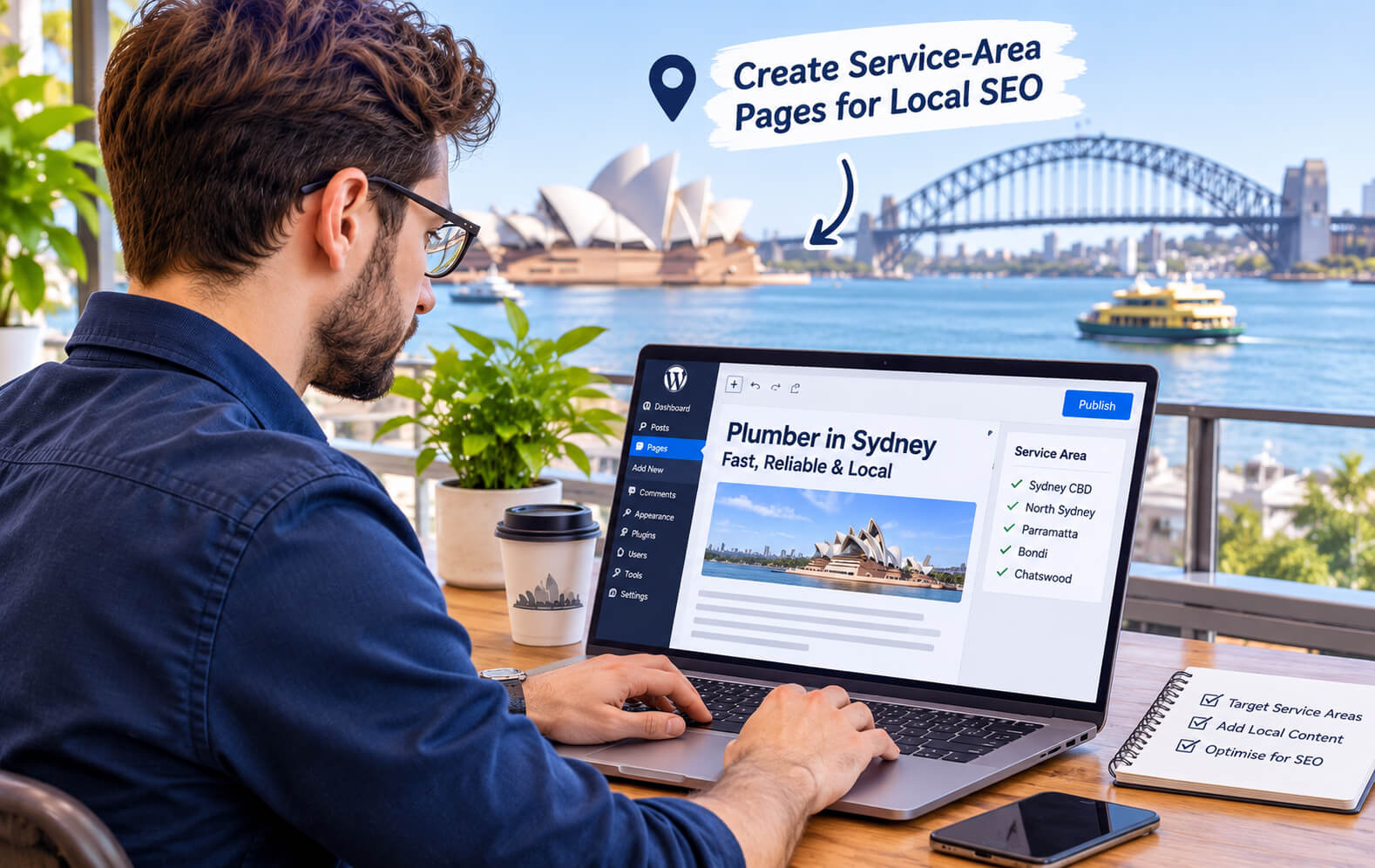
Service-area pages help Sydney small businesses show which suburbs they actually serve and give people clear next steps. Useful pages describe real coverage, jobs or local details rather than swapping a suburb name into identical copy. They support relevance signals alongside a complete Google Business Profile and consistent contact details.

What service-area pages are and when they help
A service-area page is a website page focused on a specific suburb, region or service-plus-location combination that the business genuinely covers. It answers questions such as whether the business works in that area, what to expect, and how to enquire.
These pages suit service-area businesses (plumbers, cleaners, consultants who travel) and hybrid businesses that both receive customers and travel. Storefront businesses usually rely more on a single location page linked from their Google Business Profile.
Google’s local ranking factors centre on relevance, distance and prominence. Accurate service-area settings on the profile (up to 20 named areas, generally within about a two-hour drive of the base) plus matching website content help the relevance part. Distance still depends on the searcher’s location.
Doorway pages versus useful location pages
Google’s spam policies list doorway abuse as pages created to rank for similar queries that lead users to intermediate pages less useful than the final destination. One example is multiple pages targeted at specific regions or cities that funnel visitors to one page.
A useful service-area page stands on its own. It includes something true only of that area (recent jobs, local landmarks, typical travel times, relevant photos or reviews from customers there). A thin page that merely replaces “Parramatta” with “Bondi” in the same paragraphs matches the pattern Google describes.
Most thin pages are simply ignored or not indexed rather than triggering a manual action, but they waste crawl resources and add little for users.
Practical steps for Sydney operators
Start with the Google Business Profile. Confirm the service areas match where the team regularly works. Hide the address if customers never visit a staffed location.
Then decide which website pages are justified:
- One strong overview page for the broader service area (for example Western Sydney).
- Individual suburb pages only where there is real proof of work or a clear commercial reason.
For each page:
- Use a clear URL such as /areas/parramatta or /plumber-parramatta.
- Write a unique introduction that states the service and the specific area.
- Add one or two concrete local details (typical response time, recent job type, nearby landmark).
- Include a direct enquiry option (phone, form or link to contact page).
- Link to the main service page and to the Google Business Profile where appropriate.
Keep the number of pages realistic. Ten near-identical pages usually help less than three well-supported ones.
Content that makes a page worth ranking
Useful elements include:
- Short description of recent or typical work in that suburb.
- Photos of actual jobs (with permission).
- Quotes or review excerpts that mention the area.
- Practical notes such as parking, access or common local issues.
- Clear statement of service hours or response expectations.
Avoid lists of every Sydney suburb or keyword blocks. Australian English and plain language work best. Mention landmarks or postcodes only when they add real information.
Internal links should point to related service pages and to the broader area overview. This helps both users and search systems understand the site structure. Consistent name, address or service-area description and phone number (NAP) across the site, profile and major directories further reduces mixed signals. The existing guide on consistent local directory listings covers the matching process.
Common limitations and next steps
Service-area pages do not override distance. A business based in Penrith will still rank more easily for nearby searches than for searches in the eastern suburbs. Pages also need ongoing maintenance as service areas change.
Owners who want support with page structure, content planning or on-page recommendations can review SEO services. These sit alongside website foundations covered in website design priorities and the wider practical digital marketing strategy.
Conclusion
Useful service-area pages give Sydney small businesses a clear way to show where they work and answer local questions. Focus on real coverage, unique details and a complete Google Business Profile rather than volume. The result is content that serves both customers and local search systems without crossing into doorway territory.
Frequently Asked Questions
Do I need a separate page for every Sydney suburb I serve?
No. Build a strong overview page for the overall service area, then add individual suburb pages only where you have genuine local proof or a clear commercial reason. Ten near-identical pages usually add less value than three well-supported ones.
What does Google say about service-area pages and doorway pages?
Google’s spam policies describe doorway abuse as pages created to rank for similar queries that funnel users to a less useful destination. Multiple pages targeted at specific cities or regions that lead to one page are listed as an example. Pages with unique, area-specific information are treated differently.
How many service areas can I set on my Google Business Profile?
Google allows up to 20 service areas defined by suburb, postcode or similar. The overall area should generally stay within about a two-hour drive of the business base, though some businesses can justify a larger area.
Should a service-area business show its address?
If customers never visit a staffed location, hide the address on the Google Business Profile and list the service areas instead. The address is still used for verification.